

Fun facts comets reveal that these icy celestial wanderers are ancient remnants from our solar system’s formation roughly 4.6 billion years ago. Composed of frozen gases, rock, and dust, comets develop glowing atmospheres and massive tails extending millions of miles when approaching the intense heat of the Sun.
Have you ever looked up at the night sky and wondered what secrets those glowing celestial travelers are hiding as they streak across space? Uncovering surprising fun facts comets carry brings the mysterious outer edges of our solar system right down to Earth.
You do not need an advanced astrophysics degree or a giant observatory telescope to appreciate the wild science behind these icy wanderers. Let us take an exciting look at how cosmic snowballs shape space history.
Whether you are curious about glowing tails stretching millions of miles or ancient space dust, discovering fun facts about comets satisfies your natural curiosity. You will find incredible astronomical stories and scientific answers waiting right here.
Get ready to discover cosmic snowballs, ancient organic ingredients, and annual meteor showers, and find out why comet research is your absolute favorite star-gazing topic.
What Are Comets Made Of, Really
The Famous Dirty Snowball Concept
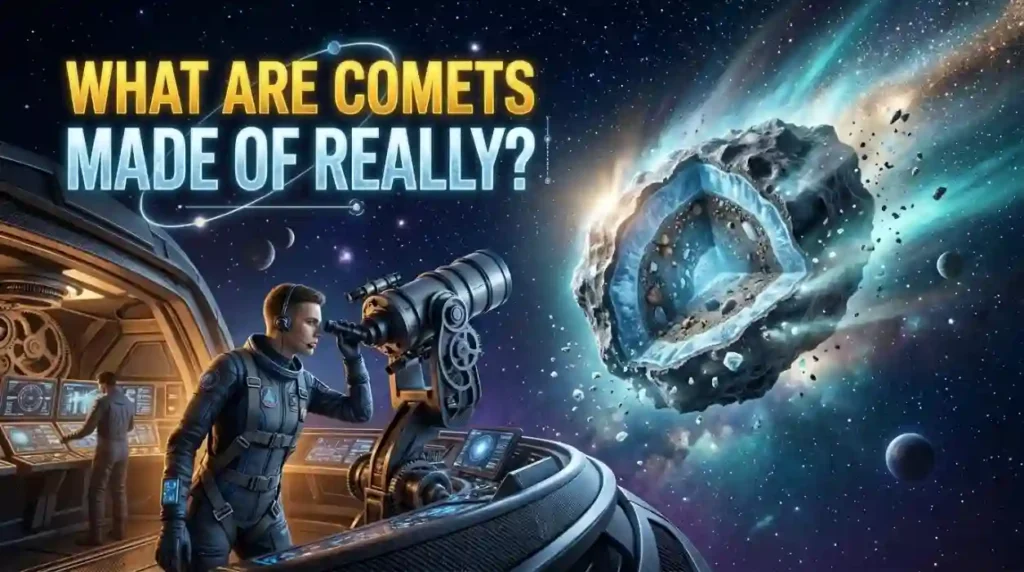
Astronomer Fred Whipple famously described comets as giant dirty snowballs tumbling through the vacuum of space. They consist of a solid, frozen core called a nucleus, packed with frozen water, ammonia, carbon dioxide, methane, and ancient cosmic dust grains.
How Solar Radiation Awakens Sleeping Nuclei
When a comet travels through the freezing depths of space far from solar heat, it remains completely frozen and dark. As its elliptical orbit draws it closer to the Sun, intense solar radiation heats up the icy surface, causing frozen gases to convert directly into vapor through sublimation.
- Water ice turning into vapor without ever melting into liquid water first
- Trapped dust particles exploding outward as gas vents open up on the surface
- Creating a glowing cloud of gas and dust called a coma around the nucleus
The Anatomy of a Cosmic Visitor

The Core Nucleus
The nucleus represents the solid physical body of the comet, often measuring anywhere from a few hundred meters to dozens of kilometers across. Despite holding huge amounts of reflective ice, the surface layer looks as dark as charcoal due to thick coatings of organic dust.
The Glowing Coma
As sublimation speeds up near the Sun, a massive temporary atmosphere called a coma forms around the nucleus. This glowing cloud can expand to become larger than giant planets like Jupiter, reflecting bright sunlight toward Earth telescopes.
- Solar heat strikes the frozen nucleus, causing trapped gases to expand rapidly
- Venting gas shoots outward, carrying microscopic dust grains into surrounding space
- A glowing coma envelops the nucleus, stretching hundreds of thousands of miles wide
- Solar wind pushes light gas and heavy dust particles into distinct trailing tails
The Twin Tails Streaming Into Space
Comets do not possess just one single tail when passing near the Sun; they actually form two distinct tails pointing in slightly different directions. Understanding these twin tails reveals how solar forces interact with floating cosmic particles.
The Blue Ion Tail
- Formed from electrically charged gas molecules pushed directly away from the Sun by solar wind
- Always points straight away from the Sun regardless of the comet’s physical direction of motion
- Glows with a distinct bluish light caused by ionized carbon monoxide gas
The White Dust Tail
- Composed of heavier microscopic dust grains pushed gently by solar light pressure
- Curves gracefully behind the comet along its orbital trajectory path
- Reflects white sunlight brightly, making it easily visible to naked human eyes
Where Do Comets Come From originally

The Kuiper Belt: The Nearby Icy Ring
Short-period comets take less than two hundred years to complete a single orbit around the Sun. These frequent visitors originate inside the Kuiper Belt, a flat ring of icy bodies orbiting just beyond Neptune’s path.
The Oort Cloud: The Distant Frozen Shell
Long-period comets take thousands or even millions of years to complete one giant orbit. They originate inside the distant Oort Cloud, a giant spherical shell surrounding our entire solar system almost halfway to the nearest neighboring star system.
- Gravitational nudges from passing stars knocking distant Oort Cloud objects inward
- Planetary gravity shifts pushing Kuiper Belt objects into new solar orbits
- Extreme elliptical paths taking comets close to the Sun before flinging them back out
Famous Comets That Changed History

Halley’s Comet: The Predictable Regular Visitor
Halley’s Comet represents the most famous comet in human history, returning to view from Earth every seventy-five to seventy-six years. Mark Twain was famously born during a Halley’s Comet appearance in eighteen thirty-five and died during its next return in nineteen ten.
Shoemaker-Levy 9: The Jupiter Crash
In nineteen ninety-four, astronomers watched in awe as Comet Shoemaker-Levy 9 ripped apart under Jupiter’s massive gravitational forces. Dozens of icy fragments slammed directly into Jupiter’s atmosphere, leaving dark scars larger than planet Earth visible for months.
- Halley’s Comet documented by ancient Chinese astronomers as far back as two hundred BCE
- Comet Hale-Bopp remaining visible to naked eyes for a record eighteen months in nineteen ninety-seven
- Great Comet of eighteen forty-three featuring a tail stretching over two hundred million miles long
How Comets Create Spectacular Annual Meteor Showers

Crossing Paths With Cosmic Dust Trails
As comets travel along their orbital paths, they shed millions of tons of microscopic dust and tiny gravel bits behind them. When Earth’s orbit passes directly through one of these dense dust trails every year, tiny space rocks slam into our atmosphere.
Friction and Glowing Shooting Stars
As cosmic dust particles hit Earth’s upper atmosphere at extreme speeds, friction creates intense heat that vaporizes the debris instantly. This glowing streak of light across the night sky forms what we popularly call a shooting star or meteor.
Practice Exercise
- What common two-word phrase did astronomer Fred Whipple use to describe the physical composition of a comet?
A. Golden asteroid
B. Dirty snowball
C. Frozen planet
D. Burning meteor - Why do comets form glowing tails only when they draw close to the Sun?
A. They rub against atmospheric friction clouds surrounding Earth
B. Solar radiation heats frozen gases, causing sublimation and gas release
C. Stars in the background project light through the icy core
D. Nuclear explosions occur inside the comet nucleus automatically - Where do short-period comets with orbits taking under two hundred years originate?
A. The asteroid belt between Mars and Jupiter
B. The outer edges of the Andromeda galaxy
C. The Kuiper Belt beyond Neptune
D. The surface of the planet Saturn - What creates the bright shooting stars seen during annual meteor showers on Earth?
A. Satellites falling out of low Earth orbit
B. Microscopic comet dust burning up due to atmospheric friction
C. Solar flares bouncing off atmospheric clouds
D. Pieces of the Moon breaking off during high tides - Which famous comet collision with Jupiter was observed directly by astronomers in 1994?
A. Halley’s Comet
B. Comet Hale-Bopp
C. Comet Shoemaker-Levy 9
D. Comet Encke
Answer Key:
1. B
2. B
3. C
4. B
5. C
FAQs
What is the main difference between an asteroid and a comet?
Asteroids consist primarily of rock and metal found in the warm inner solar system. Comets contain ice, frozen gas, and dust originating from cold outer space, forming glowing tails near the Sun.
Does a comet’s tail always follow directly behind it?
A comet’s tail does not simply follow behind its path of travel like smoke behind a car. Solar wind pushes the gas tail straight away from the Sun, meaning the tail leads when traveling away.
Can a comet ever strike planet Earth?
Comet impacts are extremely rare because planetary gravity keeps orbits mostly stable over millions of years. Space agencies track near-Earth objects continuously to ensure early warning detection for any potential orbital intersections.
What causes comets to smell like rotten eggs?
Comet atmospheres contain hydrogen sulfide, ammonia, and formaldehyde released during ice sublimation. Space probes analyzing comet gases report scents resembling rotten eggs, sharp ammonia, and vinegar mixed in space.
Did comets bring water to early planet Earth?
Scientists believe ancient comet and asteroid impacts during Earth’s early history delivered significant amounts of water ice. This celestial bombardment helped fill oceans and provided organic compounds necessary for early life development.
How long do comets survive after repeated visits near the Sun?
Comets lose significant layers of ice and dust every time they swing close to the Sun. Eventually, they exhaust their volatile ice, leaving behind dull rocky rubble or breaking apart into meteor streams.
Conclusion
Exploring these icy cosmic travelers helps us piece together how our solar system formed over four billion years ago. From giant frozen nuclei and brilliant twin tails to atmospheric shooting stars, these ancient remnants hold the keys to understanding our space origins.
Keeping your eyes on the night sky reminds us of how dynamic and fascinating our solar system continues to be. For more amazing astronomy guides and space discoveries, explore our favorite fun facts comets collection.
Grab your binoculars during the next meteor shower, share space trivia with friends, and enjoy the wondrous visual history of our cosmic neighborhood!

Rose Amili is the writer behind LaughSphere.com, a website where learning meets curiosity and fun. She enjoys exploring fascinating facts, surprising stories, science, history, nature, weather, and many other interesting subjects. Her writing style is simple, friendly, and easy to understand, making information enjoyable for readers of all backgrounds.
Through LaughSphere.com, Rose Amili hopes to spark curiosity and encourage readers to discover something new every day. She believes even an ordinary topic can become interesting when it is shared from a fresh and engaging perspective. Her goal is to create useful, enjoyable content that readers can understand easily, remember, and share with others.