

Fun classroom activities are interactive, student-centered learning games and collaborative challenges designed to boost participation, deepen comprehension, and make lessons memorable. By blending movement, friendly competition, and creative problem-solving into daily instruction, teachers transform passive lectures into lively, high-energy educational experiences for learners of all ages.
Have you ever looked across a classroom of sleepy faces during a Friday afternoon lesson and wished you could flip a magic switch to wake everyone up? Bringing fun classroom activities into your daily teaching plan turns quiet, distracted rooms into lively hubs of genuine curiosity.
You do not need expensive smartboards or hours of complicated prep work to get students excited about learning. Let us look at how simple games and collaborative challenges transform everyday lessons.
Whether you teach elementary science or high school history, using fun classroom activities helps students retain difficult concepts effortlessly. You will find practical, low-prep game ideas and classroom management tips waiting right here.
Get ready to discover movement-based review games, creative group puzzles, and rapid-fire trivia engineered to make fun classroom activities your favorite teaching superpower.
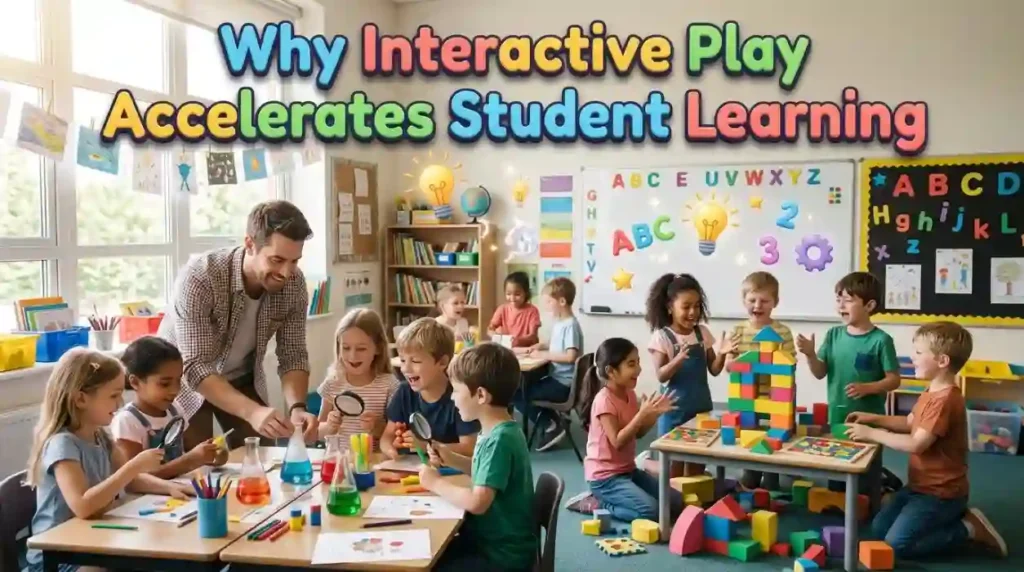
Why Interactive Play Accelerates Student Learning
How Dopamine and Movement Strengthen Memory
When students sit passively in rows listening to long lectures, their brains quickly tune out and stop encoding new information. Introducing active participation triggers dopamine release, which acts like a biological highlighter marking key facts for long-term memory storage.
Building Classroom Community and Safe Risk-Taking
Playful group challenges lower the fear of making mistakes in front of peers. When learning feels like a team game, shy students speak up more freely, support their classmates, and develop stronger social confidence.
- Turning passive note-taking into active, hands-on problem-solving
- Improving focus and reducing off-task chatter through structured energy outlets
- Helping visual, auditory, and kinesthetic learners grasp tough subjects together
Breaking Down Complex Topics Step by Step
Games naturally break intimidating lessons into small, bite-sized missions. Instead of facing a giant worksheet alone, students tackle one clue or round at a time, building momentum and pride with every small win.
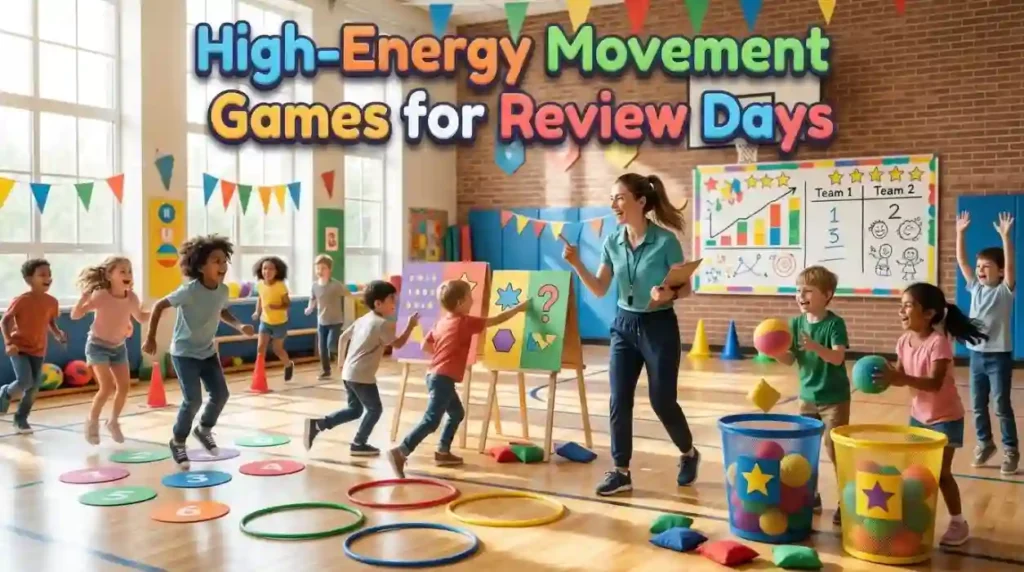
High-Energy Movement Games for Review Days
Four Corners Opinion and Trivia Shuffle
Label the four corners of your classroom with letters A, B, C, and D, then project a multiple-choice review question on the board. Students physically walk to the corner matching their chosen answer, creating an instant visual poll and sparking lively peer debates before you reveal the solution.
Classroom Gallery Walk and Sticky-Note Feedback
Post large sheets of chart paper featuring different prompts, math problems, or historical images around the classroom walls. Small groups rotate from station to station with markers, adding their thoughts and reviewing previous teams’ work like art critics at a museum opening.
- Hang five to six large poster sheets evenly spaced around the room walls
- Divide students into small teams of three or four with different colored markers
- Give each group three minutes at a station to solve the prompt or add fresh ideas
- Ring a cheerful chime to signal groups to rotate clockwise to the next poster
Trashketball Review Shootout
- Placing an empty recycling bin or plastic bucket at the front of the room with taped score lines
- Letting teams earn a shot with a soft foam ball every time they answer a review question correctly
- Awarding bonus points from farther tape lines to build stadium-level excitement during test prep
Managing Noise Levels During Active Games
- Establish a clear attention signal, such as a call-and-response clap, before starting any game.
- Practice walking feet rules so excitement never turns into hallway-style running.
- Keep rounds brisk with a visible countdown timer projected on the screen
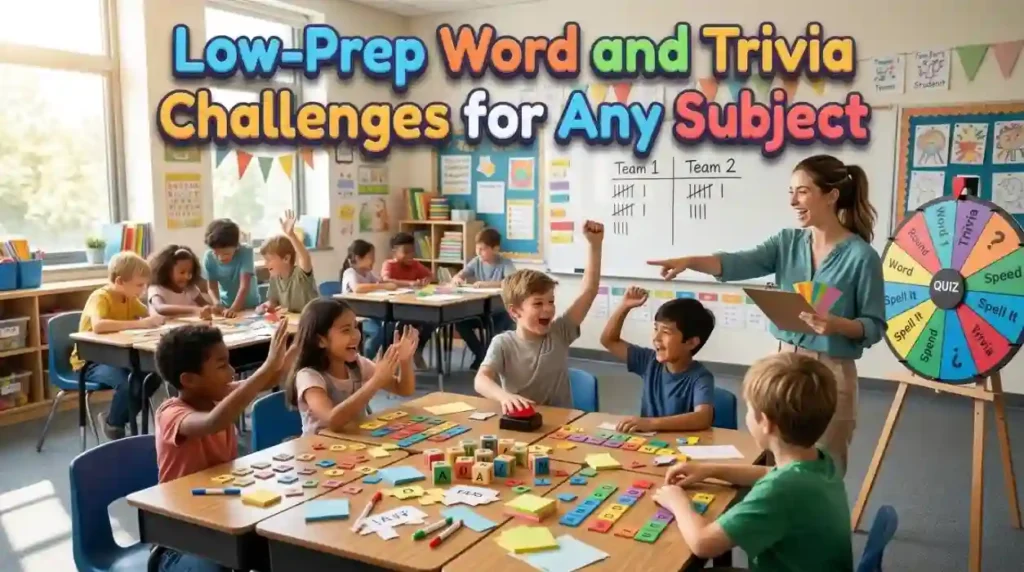
Low-Prep Word and Trivia Challenges for Any Subject
Two Truths and a Lesson Lie
Challenge students to write down three statements about today’s reading or science topic—two factual statements and one clever falsehood. Classmates listen closely and vote on which statement is the bluff, forcing everyone to analyze details critically.
Password and Taboo Vocabulary Showdowns
Write a key vocabulary term on the board behind a student sitting in the “hot seat” facing the class. Teammates take turns giving one-word clues to help the guesser identify the secret concept without saying forbidden root words.
- Hosting lightning-round whiteboard races where every student holds up quick answers
- Playing vocabulary bingo using custom grids filled with current unit terms
- Running “Who Am I?” sticky-note games where students wear famous historical names on their backs
Musical Chairs Concept Match
Arrange chairs in a circle with review cards placed on each seat while upbeat instrumental music plays. When the music stops, students sit down and immediately answer the question or define the term resting on their chair.
Creative Collaborative Projects and Escape Rooms

DIY Paper-Based Classroom Escape Rooms
You do not need expensive padlocks or wooden boxes to run an unforgettable classroom escape room. Simply place five envelope stations around the room, where solving the math or grammar puzzle inside Envelope One reveals the secret four-digit code needed to unlock Envelope Two.
Sixty-Second Commercial or Skit Pitch
Give small groups ten minutes to write and perform a hilarious sixty-second television commercial selling a historical invention, a geometric shape, or a punctuation mark. Watching classmates pitch the benefits of the semicolon or the wheel guarantees unforgettable laughs and deep conceptual mastery.
- Designing fictional social media profiles for famous scientists or novel characters
- Building tallest-tower engineering challenges using only index cards and masking tape
- Creating comic strips that summarize key chapters or scientific cycles step by step.
Tips for Fair Group Formation
- Use playing cards, colored craft sticks, or birthday months to mix student groups randomly.
- Assign clear team roles like timekeeper, scribe, materials manager, and presenter.
- Keep groups small, ideally three to four students so nobody sits idle on the sidelines.
Adapting Activities for Different Age Groups and Subjects

Elementary School Explorers
Younger learners thrive on imaginative roleplay, physical movement, and bright visual props. Games like “Simon Says” with science vocabulary or scavenger hunts for geometric shapes around the classroom keep little hands and minds happily busy.
Middle and High School Thinkers
Older students appreciate friendly competition, clever humor, and autonomy over their creative choices. Debate tournaments, murder-mystery history investigations, and fast-paced quiz show formats tap into their competitive spirit without feeling childish.
Practice Exercise
- Why does physical movement during lessons help students remember information better?
A. It makes the classroom temperature drop by twenty degrees
B. It triggers dopamine release and increases blood flow, strengthening memory encoding
C. It allows students to skip taking any tests for the rest of the year
D. It erases all previous homework assignments automatically - How does the “Four Corners” review game encourage participation from every student?
A. Only the fastest runner in the room is allowed to answer questions
B. Students sit silently with their eyes closed for forty minutes
C.Every student physically moves to the corner matching their answer, creating an instant visual poll
D. The teacher answers every question alone while students watch - What is the main advantage of using an envelope-based classroom escape room?
A. It requires buying hundreds of dollars worth of electronic locks
B. It uses simple paper envelopes and sequential codes to create thrilling teamwork on a zero-dollar budget
C. It locks students inside the building until midnight
D. It replaces all textbooks permanently across every grade level - Why should teachers keep collaborative game groups small, ideally three to four students?
A. So every student has an active role, and nobody sits idle on the sidelines
B. Because classroom desks cannot hold more than two pencils at once
C. To prevent students from ever speaking to one another
D. Because larger groups violate state fire safety codes - How does the “Two Truths and a Lesson Lie” activity deepen student comprehension?
A. It teaches students how to tell convincing lies to their parents
B. It requires students to analyze facts closely to spot subtle errors in lesson details
C. It eliminates the need to read any assigned chapters
D. It turns every class into a silent nap period
Answer Key:
1. B
2. C
3. B
4. A
5. B
FAQs
How can I fit fun activities into a packed curriculum schedule?
Use quick five-to-ten-minute review games as warm-up bell ringers or end-of-class exit tickets rather than sacrificing full lecture days. Short, focused bursts of active play reinforce core standards faster than passive worksheet drills, actually saving re-teaching time later.
What if a game gets too loud and disrupts neighboring classrooms?
Set clear volume expectations before starting, such as using “restaurant voices” instead of stadium shouting, and use silent hand signals or chimes to pause play immediately. Practicing transitions once or twice teaches students that keeping noise respectful earns more game time.
How do I include shy or introverted students who dislike spotlights?
Choose collaborative partner or small-group activities where shy students can contribute ideas quietly without speaking alone in front of the entire class. Offering written roles like clue decoder or team strategist lets introverted learners shine comfortably.
Can fun classroom activities work in high school or college courses?
Older students love fast-paced quiz bowls, mock trials, escape rooms, and structured debates just as much as younger kids do. Framing games around real-world puzzles, strategy, and friendly bragging rights keeps teenagers and adults fully engaged.
What are the best zero-prep activities for a substitute teacher or sudden schedule change?
Games like “Two Truths and a Lie,” “Four Corners,” whiteboard Pictionary, and “Twenty Questions” using current vocabulary words require zero printed handouts or supplies. Keeping three zero-prep games in your mental toolkit helps you handle unexpected schedule shifts.
How do I handle overly competitive students who get upset when losing?
Emphasize team cooperation, award points for creative explanations or good sportsmanship, and keep prizes lighthearted like stickers or extra bragging rights. Rotating teams frequently ensures everyone experiences winning and keeps classroom culture supportive.
Conclusion
Bringing energy, curiosity, and structured play into your daily lessons is one of the surest ways to help students fall in love with learning. Whether you run a quick Four Corners review shuffle, challenge teams with a paper envelope escape room, or spark laughs with a sixty-second vocabulary commercial, active engagement transforms how learners connect with new ideas.
You do not need elaborate supplies to make lessons memorable just a willingness to let students move, collaborate, and explore concepts together. For more creative teaching inspiration and ready-to-use lesson ideas, explore our complete collection of fun classroom activities.
Pick one simple game from this guide for your next lesson, watch your students light up, and enjoy the magic of joyful learning!

Rose Amili is the writer behind LaughSphere.com, a website where learning meets curiosity and fun. She enjoys exploring fascinating facts, surprising stories, science, history, nature, weather, and many other interesting subjects. Her writing style is simple, friendly, and easy to understand, making information enjoyable for readers of all backgrounds.
Through LaughSphere.com, Rose Amili hopes to spark curiosity and encourage readers to discover something new every day. She believes even an ordinary topic can become interesting when it is shared from a fresh and engaging perspective. Her goal is to create useful, enjoyable content that readers can understand easily, remember, and share with others.